Showing posts with label Fantasy Masterworks. Show all posts

Sunday, July 21, 2013

New stuff, and lots of it

As I'm already an unfeasibly long distance away from ever catching up with Orion's publication schedule, I can only celebrate rather than be daunted by the fact that the Fantasy Masterworks series is going to be revived.

The first five titles have now been announced, and I've added them to the sidebar. Unsurprisingly, bearing in mind the changes that have been made to the SF Masterworks series, the revived series will be unnumbered and boasts an attractive new uniform cover design template.

I've also added links and images to the slew of new SF Masterworks titles for which pre-publication details have been released.

Friday, December 14, 2012

Year-end update

As usual, I find myself apologising for the slow progress I've made in advancing this project during 2012. Posts have been infrequent and seldom as expansive as I would have liked.

As is customary here, matters have been exacerbated by the fact that more new books, both print and digital, have come into the house during the past twelve months than have been read. Plus ça change, and all that.

You'll probably not fall into a dead faint if I plead the usual reasons of time constraints (somewhat ironically for an avid reader of speculative fiction, I know), and the fact that my consultancy has had a good year.

Beyond this, I do have a couple of pieces of relevant news to convey.

Firstly, I started co-curating new client (and publisher of the SF and Fantasy Masterworks, of course) Orion's SF Gateway's social presences on Twitter, facebook and Pinterest in November 2012, which has been a lot of fun. Consequently, I'll be adding ebook reviews of the SF Gateway titles I buy (yes, buy) on the blog in the future. In fact, I'm reading one at the moment. I'm also hoping that if it's true that ereader users read more books than print readers, the imbalance in my buying-to-reading ratio may move in the right direction in 2013.

Secondly, I've added some code to the Blogger template in order that social buttons now appear at the bottom of each post.

Enjoy the holidays, and happy reading in the new year and beyond.

Tim Powers, The Anubis Gates (1983) FMW 47

"One of these time gaps is just outside Kensington, five miles from the Strand, on the evening of the first of September, 1810. And unlike most gaps that close to the 1802 source, this one is four hours long."

Time travel, demonic magicians, werewolves, cross-dressing heroines, Romantic poets and Egyptian gods: The Anubis Gates is a sovereign salmagundi of some of the pillars of speculative fiction.

Laphroaig-swilling, cigar-toting literary professor for hire Brendan Doyle is commissioned by plutocrat J. Cochran Darrow to travel back to 1810 through a time gate in order to verify the identity of stoner sonneteer Samuel Taylor Coleridge.

Suffice to say, things don't go according to plan.

The principal enjoyment of The Anubis Gates lies in allowing oneself to be dazzled by the pyrotechnics of the tale itself, and as such there is little purpose in rehearsing the panoply of plot twists the work provides. It is a novel of incident rather than ideas which places a premium on the pleasures of thematic divagation rather than focused rumination and as such is a far from taxing, albeit thoroughly enjoyable, read.

Winner of the 1983 Philip K. Dick Award, The Anubis Gates is an entertaining, undemanding, and fully immersive entry into the Fantasy Masterworks series.

Sunday, June 24, 2012

Ray Bradbury, Something Wicked This Way Comes (1962) FMW 49

I picked this off the virtual shelf (although I also have the print copy) after the recent death of Ray Bradbury as a way of honouring the passing of an influential and much-loved author whose works I am not as conversant with as I would like to be.

Something Wicked This Way Comes describes the encounter of adolescents Will Halloway and Jim Nightshade with the mysterious Cooger & Dark's Pandemonium Shadow Show, an eerie circus sideshow that arrives in the middle of the night by railroad.

On discovering the dark purposes of the troupe's visitation, Halloway and Nightshade do what they can to stave off its threat to their own persons as well others prior to embroiling Halloway's father Charles in events.

Stylistically, I found the work uneven. Bradbury seems to lurch between the most chokingly florid prose and undeniably majestic passages that are startling and arresting in equal measure.

Structurally, the novel is disappointing. For me, the plot lacks interest and development and Bradbury relies on careering from set piece to set piece in order to retain such engagement as the work is able to muster. Personally, I found this tedious in the extreme.

Thematically, the struggle between an under-defined evil and a less-than-convincing goodness lacks interest, the depiction of adolescence is strained, and the delineation of the father-child relationship too oblique.

Consequently, more than once I felt I was left 'holding a book but reading the empty spaces' (loc. 487-77). However, Something Wicked This Way Comes does deliver some wonderful passages between the breathless and underwhelming plot devices, and is an acceptable late entry in the numbered run of the Fantasy Masterworks series.
For these beings, fall is the ever normal season, the only weather, there be no choice beyond. Where do they come from? The dust. Where do they go? The grave. Does blood stir their veins? No: the night wind. What ticks in their head? The worm. What speaks from their mouth? The toad. What sees from their eye? The snake. What hears with their ear? The abyss between the stars. They sift the human storm for souls, eat flesh of reason, fill tombs with sinners. They frenzy forth. In gusts they beetle-scurry, creep, thread, filter, motion, make all moons sullen, and surely cloud all clear-run waters. The spider-web hears them, trembles - breaks. Such are the autumn people. Beware of them. (loc. 2892-96)
Life in the end seemed a prank of such size you could only stand off at this end of the corridor to note its meaningless length and its quite unnecessary height, a mountain built to such ridiculous immensities you were dwarfed in its shadow and mocking of its pomp. (loc. 3436-38)

Saturday, October 15, 2011

Orion launches SF Gatweway

Congratulations to Gollancz's Darren Nash on the launch of the highly promising SF Gateway. I was taken with this proposition as soon as I read the following press release:
Imagine your perfect specialist bookshop; it stocks not just the highlights from your favourite authors’ careers, but every book they ever wrote and the people who run the shop have an encyclopaedic knowledge of SF. The future of Science Fiction and Fantasy e-book publishing is here. We invite you to join us.
Suddenly, owning a Kindle seems very important. I say more about why I feel such initiatives as SF Gateway are significant to the future of publishing here.

Much as purchasing another electronic device doesn't fill me with glee, I have to concede that the limitations of the battery on my current HTC phone means that reading SF Gateway titles on my Kindle Android app is not a viable option. I will therefore be adding an SF Gateway review section as soon as I've purchased a dedicated e-reader, and have read my first title from the launch list.

As long-time readers of this blog know, nothing happens quickly around here, so such developments are unlikely to take place before the end of 2011. Of course, by that time I may have decided to get an Android tablet instead - or perhaps a spare battery for my phone.
In other news that is bound to cheer readers of this blog, Gollancz have used the SF Gateway forum to announce the welcome return of the Fantasy Masterworks list. I've put in a plea that the numerical sequence and ormer fcover design are retained. If you feel the same way, please add a comment to this thread.

Sunday, September 26, 2010

A change of pace

Welcome back, and thanks for staying with me during the hiatus since my last post.

This blog has been in existence since 2005, and by rights I should have finished this project by now. However, I seldom find myself at liberty to compose the long-form reviews that this site has characteristically offered in the past. I am still finding time to read, as I hope you are, which is a good thing, but my appetite to move on to the next work has been diminished by the feeling that I should sit down and write a review first. This means I am reading less, yet not writing more, which is a far from ideal state of affairs.

The relaunch of the SF Masterworks imprint as an unnumbered series is now merely adding to the pressure. I have therefore decided to change the approach I take to the composition of reviews. From hereon in, I shall be offering short-form reviews which are impressionistic rather than exhaustive in their approach. If I find myself with the time to write additional content in the future, then I will do so. However, this blog was intended to be a spur to my reading rather than an obstacle to it, so whilst the critic in me undertakes this reorientation only reluctantly, I appreciate - sat here in front of my bookshelves as I am - that I need to pick up the pace if I am going to make any appreciable headway with the series.

I also hope to make this site rather less of the resolutely stolid 'web 1.0' vehicle that it is, and hope to add more social elements. To that end, thank you for your continuing support and interest in this project, and do please reach out with any comments or observations you may have.

Monday, May 31, 2010

Michael Moorcock, The History of the Runestaff (1967-69, rev. 1977, rev. 1992) FMW 36

First there was the Red Amulet, its ruddy light staining their faces as if with blood. This was Hawkmoon's strength, giving its owner more than natural energy. Then there were the crystal rings of Mygan which could transport those who wore them through the dimensions. These were their passports back to their own space and time. Beside the rings was the scabbarded Sword of the Dawn. In this lay Hawkmoon's army [Legion of the Dawn]. And finally, wrapped in a length of cloth, there was the Runestaff, Hawkmoon's standard and his hope. Count Brass cleared his throat. “Even with all these powerful objects can we defeat an empire as great as Granbretan?” (p. 591).

Published in 2003, the 36th entry in the Fantasy Masterworks series reprints the 1992 edition of the third volume in the Tale of the Eternal Champion series, a '14 volume set of omnibuses that present a considerable number of Michael Moorcock's Eternal Champion novels and stories in a 'recommended reading order'.

The Mutiverse.org summary linked to above tells only part of the story, as each of the four volumes in the Hawkmoon tetralogy ('The Jewel in the Skull', 'The Mad God's Amulet', 'The Sword of the Dawn', and 'The Runestaff') originally written in the late 1960s had already undergone revisions in 1977: '[The Tale of the Eternal Champion] was originally published by Millennium/Orion in hardcover and trade paperback editions between 1992 and 1993, and then in mass-market paperback editions between 1995 and 1998. The series was jointly edited by Moorcock and John Davey, and presented Moorcock with an opportunity to make a number of revisions to the texts to give a more uniform feel to the Tale. Each omnibus also contained a new Introduction by Moorcock', which is included in this Fantasy Masterworks edition. A further trilogy featuring Hawkmoon entitled 'Count Brass' (comprising 'Count Brass', 'The Champion of Garathorn' and 'The Quest for Tanelorn') was published as the fourteenth and final volume in the 1992-93 cycle.

Despite such an assiduous editorial history, no-one appears to have picked up on the fact that Moorcock's co-dedicatee, 'my friend Mr Ian Kilminster' (sic; p. iii), doesn't spell his name the way the author does. No matter, although as a big fan of Motörhead as well as Moorcock's oeuvre, the persistence of the typo grates somewhat. To the point:

The sequence is set in a future earth, at least 1,000 years from the present. There are hints that the setting is a post-apocalyptic nuclear one: 'the 'ancient people of [Count Brass's] Kamarg [the French Camargue] who were preserved by Fate from the blight of the Tragic Millennium[...] whose ancestors were saved by the fierce mistral that cleansed the skies of the poisons that brought others death and malformation [who] give thanks[...] for the coming of the Life Wind' (pp. 24-25)


During the Tragic Millennium, 'the world collapsed into various degrees of ruin' (p. 37) and 'desolation', and 'nothing has lived there but malformed creatures since' (p. 383). The protagonist's chaotic associate, the appositely named Huillam D'Averc has cause for concern that the maladies of the Tragic Millennium, which we recognize as radiation sickness, endure: “There could be poison air – the air that makes your flesh crumple from your face, that causes vomiting and death...”. To this observation, Hawkmoon replies “The poison air does not exist any more, D'Averc, and you know it. It only lasts for a while and then disappears. Surely there has been no poison air here for centuries'. (p. 406)

If the air of taint that hangs over the geography of the West in these novels can be seen to reflect in some way the author's own jaundiced views of the continent, then his metaphorical description of the temperament of his own countrymen is no more sympathetic. From Normandia to Ukrania, the land mass is in thrall to the decadent and cruel Granbretanians: 'their cruelty is without precedent. They are insane. Their souls are sick with a love for all that is evil, and a hatred for all that is noble'. (p. 21).

However, Moorcock's critique of Granbretan is more than a side-swipe at late '60s Britain. It also serves as a commentary upon imperialism and war overall. The Vietnam war was at its height when the sequence were originally composed between 1967-69, and their dehumanizing affect hangs like a pall over the works: 'For this was the great power of the Lords of the Dark Empire, that they valued nothing on all the Earth, no human quality, nothing within or without themselves. The spreading of conquest and desolation, of terror and torment, was their staple entertainment, a means of employing their hours until their spans of life were ended. For them, warfare was merely the most satisfactory way of easing their ennui...' (p. 344)

Subsequent to his being taken prisoner in defence of his home city, the protagonist Dorian Hawkmoon von Köln is adapted by his captor, Baron Meliadus of Kroiden, Grand Constable of the Order of the Wolf, First Chieftain of the Amies under[...] great King-Emperor Huon' (p. 31): 'He lifted a hand to his forehead and felt with a shock something there that had not been there before. It was hard and smooth. It was part of him. He shuddered' (p. 67). The Black Jewel is capable of destroying the implantee's mind, and acts as surety to bind Hawkmoon to the desire of Meliadus to abduct Count Brass's daughter Yisselda from her ancestral home in the Kamarg, the last bastion of resistance against Granbretan.

As with all of the Eternal Champion novels, there are forces at work outside the main narrative that are shaping its outcomes. This episode is merely one connection in a train of events that has already been set in motion by the mysterious artefact that gives the final work in the tetralogy its title. Many destinies are woven together 'to do the Runestaff's work which was begun when Meliadus swore upon the Runestaff his great oath of vengeance against the inhabitants of Castle Brass and thus set the pattern of events' (p. 423). The Runestaff is a implacable totem of chaos as well as peace, signifying balance, binding all who swear upon it: 'Again [Meliadus] had sworn by the Runestaff, as on that fateful morn two years before. And his action had set in motion a new pattern of history. His second oath had strengthened that pattern, whether it favoured Meliadus or Hawkmoon, and hardened all their destinies a little more strongly' (p. 331).

Whilst the four novels ostensibly chronicle the struggle of the Kamarg alliance to repel and ultimately overthrow the might of Granbretan, in truth the 'justice' which the Runestaff metes out favours the maintenance of universal balance over an exceptionally long period of time rather than the advancing of the aims and aspirations of those who call upon it in the short term. This is difficult for the protagonists to discern as the devastating manifestation of the Runestaff's power sees the appearance of the latter mask the facticity of the former:'"By the Runestaff, we need aid!" [cried Hawkmoon]. Suddenly a strange electric sensation ran through his body and he gasped, recognizing what was happening to him, realizing that he had unconsciously invoked the Runestaff. The Red Amulet, [an aspect of the Runestaff] which now glowed at his neck, spreading red light on the armour of his enemies, was now transmitting power into his body[...] Then Hawkmoon was everywhere, a whirling bringer of death' (p. 321). Hawkmoon may come to 'resent the feeling of being the puppet of some supernatural agency', but there is little he can do about it (p. 529).

Every aspect of the Eternal Champion seems to manifest a predeliction to opine at some point that his desires are simple and to express resentment at the role fate has cast for him, and Hawkmoon is no exception: 'All I seek is a little love, a little peace, and to be revenged upon those who have ravaged my homeland. Yet here I am, on a continent thousands of miles away from where I desire to be, off to seek another legendary object – and reluctantly. Perhaps we shall all understand these matters in time'. (p. 497)

Such understanding as there is to be found in the sequence resides in the fact that the concept of 'justice' is a relative one. To the observation 'you fought well and you fought for justice', Hawkmoon replies: 'Justice? Is there such a thing?' Orland Fank, a servant and aspect of the Runestaff, replies: 'it can be manufactured in small quantities[...] but we have to work hard, fight well and use great wisdom to produce just a tiny amount[...] Justice is not the Law, it is not Order, as human beings normally speak of it; it is not Equilibrium, the Correction of the Balance'. However, as Hawkmoon concludes, 'the world is still wild. The justice Fank spoke of has hardly been manufactured at all. We must try to make a little more'. (p. 646)

Wednesday, April 07, 2010

Michael Moorcock, Corum (1972) FMW 30

Despite being spread over three slim novels, the plot that drives this trilogy of novels featuring Corum, a maimed incarnation of Michael Moorcock's enduring Multiverse protagonist, the Eternal Champion, is relatively straightforward.

Prince Corum Jhaelen Irsei of the Vadhagh leaves the Castle Erorn at the bidding of his father, Prince Khlonskey in search of news of the welfare of the rest of his race in order that the latter may pass into the Chamber of Vapours and die by his own hand in the full knowledge of the fate of his race.

Corum has travelled but a little way on his quest before encountering a Mabden horde making haste towards his hereditary home, little knowing that they have already destroyed the majority of his race and are set upon razing his family pile and the inhabitants thereof in a similar manner.

Corum is captured byone of the Pony Tribes' leaders, Glandyth-a-Krae and tortured and maimed (losing his left hand and right eye) prior to being saved by an aspect of Lord Arkyn, Lord of Law. At this point, the focus of the narrative broadens and the motive force behind the Mabden's destructive campaign is revealed as being the manifestation of a realignment of the balance of Law and Chaos within the Fifteen Planes as the latter begins to best the former.

Furnished with the arcane powers of the Hand of Kwll and Eye of Rhynn allowing him to summon emissaries from other planes, Corum is tasked with overthrowing Arioch, the Prince of the Swords, Xiombard, the Queen of the Swords, and finally Mabelode, the King of the Swords.

For this reader, however, the Corum trilogy's core is philosophical rather than narrative. In a very real sense, Corum - and by extension, the figure of the Eternal Champion of which he is but a single facet - are bit players in a much larger narrative that takes place outside of the contexts of the novel as the universe's gods struggle with oneanother 'offstage', an enduring contest in which they are little more than pawns, or as Xiombard puts it "we must use mortals for ends we cannot ourselves achieve". (p. 266)

The purity of Corum's quest to avenge his family and race - seldom a pure motive - is debased in his own mind by the acts that he is compelled to undertake, and the innocents slain by the godly appendages that have been grafted on to him by his patron: "Too many crimes have been committed so that that vengeance might be won! Too many unfortunates have suffered frightful fates! Will the Vadhagh name be recalled with love - or muttered in hatred?" (p. 128).

Furthermore, the agents of Chaos seem less demonic, and their motives less abhorrent, When Corum encounters them in person. He is struck by the fact that Arioch, for example, appears to bear "no malice towards the Vadhagh. He cared for them no more no less than he cared for the Mabden parasites feeding off his body. He was merely wiping his palette clean of old colours as a painter will before he begins a fresh canvas. All the agony and misery he and his had suffered was on behalf of the whim of a careless god who only occasionally turned his attentions to the world that he had been given to rule". (p. 133). This is a perception that the Chaos gods themselves are only too quick to support: 'Arioch spoke reasonably to Corum in a low, hypnotic voice. "You see, friend Corum, these Fifteen Planes were stagnating. What did you Vadhagh and the rest do? Nothing. You hardly moved from your cities and your castles. Nature gave birth to poppies and daisies. The Lords of Law made sure that all was properly ordered. Nothing was happening at all. We have brought so much more to your world, my brother Mabelode and my sister Xiombarg."' (p. 134)

Standing apart from the forces of both Law and Chaos is the Nameless Force (p. 265), possibly a supreme being of some order who has set the forces of a Cosmic Balance in sway, and yet who seems to have no control over it - or perhaps no desire to control it. It is a moot point whether the contemplation of balance and the consquences of its disruption denude the series of suspense, or augment it. I tend to favour the latter as a function of the struggle of the protagonists rather than the mechanical pre-ordained destinies of the elect, but it is far from taxing to construct a reading wherein the former is encapsulated by the latter.

One of the irresistable charms of Moorcock's Multiverse is the pleasure that the reader may take from encoutering aspects of the Eternal Champion and his Companion in novel in new settings and combinations. The metrosexual dandy Jerry Cornelius, for example, plays a major role in the sequence as the equally fastidious Jhary-a-Conel, first appearing in the second work in the trilogy, The Queen of the Swords. As Jhary explains to a bemused Corum, who has no knowledge of his other aspects in this incarnation, "sometimes we are the same creature - or, at least, aspects of the same creature[...] I have been called Timeras and Shalenak. Sometimes I am the hero, but more often than not I am the companion to a hero". (p. 160). Elric and Erekosë also appear in the work, ultimately combining with Corum to form a fascinating gestalt entity, although through their shared histories Corum is forced to acknowledge the possibility that 'it was his fate to experience an eternity of battle, of death, of misery' (p. 312), 'the fate of the Eternal Champion' (p. 331). In conference with Elric, Corum concludes near the end of the work that "we are both doomed to play a role in constant struggle between the Lords of the Higher Worlds - and we shall never understand why that struggle takes place, why it is eternal. We fight, we suffer agonies of mind and soul, but we are never sure that our suffering is worthwhile" (p. 356)

Such revelations can, perhaps unsurprisingly, provoke somewhat morose outbursts within the sequence's protagonists. Lady Jane Pentallyon, appearing late in the trilogy in a decidely Earth-like setting (contemporary crusading is mentioned at one point, p. 334) declaims "the more one discovers the less point there seems in life at all" (p. 338)

However, the conclusion of the trilogy is more redemptive than that which precedes it may have led the reader to predict it would be. Reclaiming his hand, the god Kwll tosses off the observation "do you know that you dream of these gods - that you are stronger than they - that when you are fearful, why then you bring fearsome gods upon yourselves? Is this not evident to you?" (p. 379). It may also be more realistic that we might have expected; Jhary observes: "there are many legends which say the past was perfect or that the future will be perfect. I have seen many pasts and may futures. None of them were perfect" (p. 386)

"Do not despair entirely of this world... New gods can always be created" (p. 393)

Saturday, September 05, 2009

Clark Ashton Smith, The Emperor of Dreams (2002) FMW #26

Entitled The Emperor of Dreams, Fantasy Masterworks 26 compiles forty-four of Clark Ashton Smith’s (1893-1961) short stories, book-ended by a short essay of Smith’s entitled ‘On Fantasy’ together with his poem ‘Song of the Necromancer’, and an excellent concluding afterword by Stephen Jones. A much-vaunted friend and contemporary of H.P. Lovecraft and Robert E. Howard, Smith attained a contemporary cult following through the publication of his short prose in pulp titles such as Weird Tales. His rich, decadent writing has continued to seduce admirers of speculative fiction since he abandoned its composition in the mid-1930s.

I read this Fantasy Masterworks collection intermittently over the space of six months or so. The cumulative effects of Smith’s obsessive repetition of certain tropes (omnipotent, deranged necromancers; exotic near-eastern locales; unknown terrain within familiar locales; the mastering of protagonists' volition, and their subsequent unwilling actions) have a certain narcotic quality. They’re too potent to consume in excess over a short period of time; too addictive to leave aside indefinitely.

Despite its brevity, Smith’s short essay ‘On Fantasy’ provides some interesting pointers as to the author’s outlook both on life and his creative undertakings: ‘People who cannot endure anything with a tinge or trope of fantasy, should confine their reading to the census-returns’ (pp. 1-2); ‘Truth is what we desire it to be, and the facts of life are a masquerade in which we imagine that we have indentified the masquers.’ (p. 2)

Previously unencountered, unfamiliar zones within otherwise well-known areas are something of an obsession in Smith's work. His characters frequently find themselves within ‘a clueless maze of unreality, of deception and dubiety, where nothing [is] normal or familiar or legitimate.’ (p. 93). Similarly, readers quickly learn not to be surprised when a protagonist declaims ‘somehow, in that deceptive fog, I managed to lose my way, to miss the mile-post that would have given me my direction to the town where I had planned to spend the ensuing night.’ (p. 110).

Characters are frequent symbolically as well as topographically disorientated: “I must find my kingdom[...] I am lost in darkness, amid uncouth things, and how I have wandered here I can not remember.” (p. 320); ‘At last he found the switch; but the illumination that responded was somehow dim and insufficient.’ (p. 375).

In a similar vein, I couldn’t help but smile when one of Smith’s first-person narrators contemplates undertaking an experiment I myself conduct on a nightly basis: ‘Perhaps, if I had plenty of high-proof Scotch and Bourbon, I could walk out of this particular time-plexus into something quite different.’ (p. 538)

There is more than a mere gloss of antipathy to worldly wealth in Smith’s writing, possibly precipitated by his own precarious financial circumstances (which are well-detailed in Jones’ afterword), or perhaps engendered by an overarching belief in the futility of the pursuit of money in light of the eternity of nothingness that awaits outaide his imaginary environs, and beyond his and his readers’ lives.

The gory end appointed to the prosperous victims of the Ghorii is a case in point: ‘They and their drivers were buried from sight by the ravenous monsters, who began to devour them immediately. Boxes of jewels and bales of rich fabrics were torn open in the melee, jasper and onyx idols were strewn ignominiously in the dust, pearls and rubies, unheeded, lay weltering in puddled blood; for these things were of no value to the Ghorii.’ (p. 285).

Characters and races we encounter elsewhere in the collection who express as interest in the pursuit of financial gain are neither well-regarded nor likely to be granted a felicitous destiny by their creator: ‘This people, it seemed, were most regrettably materialistic and had long ceased to offer sacrifice and prayer to the gods; though they spoke of them with a sort of distant respect and no actual blasphemy’ (p. 80).

Stephen Jones traces Smith’s relationship with H.P. Lovecraft adroitly in his afterword, and the influence of the latter upon the former is easy to detect: ‘I have continual need of modern crowds, of glaring lights, of laughter and clangour and tumult to reassure me; and always I am afraid that such things are only an insubstantial barrier; that behind them lies the realm of ancient horror and immemorial malignity of which I have had this one abominable glimpse. And always it seems to me that the veil will dissolve at any moment, and leave me face to face with an ultimate Fear.’ (p. 89)

‘Thin is the veil betwixt man and the godless deep. The skies are haunted by that which it were madness to know; and strange abominations pass evermore between earth and moon and athwart the galaxies. Unnamable things have come to us in alien horror and will come again. And the evil of the stars is not as the evil of Earth.’ (p. 181)

‘The formula, at frequent intervals, was cadenced with fatal names of lethal gods; and in it were told the secret appellations of the black god of time, and the Nothingness that abides beyond time.’ (p. 280)

‘There came to him the ineffably horrifying sensation of passing beyond his proper self, beyond all that he knew as legitimate and verifiable.’ (p. 518)

A certain dark eroticism pervades Smith’s work, showing him to have been the inheritor of the continental tradition of decadence embodied in the likes of Baudelaire and Huymans: ‘Those that were fairest, whom the plague and the worm had not ravaged overmuch, they took for their lemans and made to serve their necrophilic lusts.’ (p. 132)

Smith’s desciption of the lascivious ‘half-human fiend’ (p. 397) Ujuk is viscerally graphic: ‘His teeth clashed audibly, his eyes glowed in their pouches like beads of red-hot metal, as he withdrew from his position over the girl and loomed monstrously erect before her amid the ruins of the chamber.’ (p. 401)

Towards the end of the anthology, we encounter a mage intent on cultivating human members on vegetable matter: ‘consumately, and with never failing success, the magician had joined [various parts and members of human beings] to the half-vegetable, half-animate stocks on which they lived and grew thereafter[…] there were other graftings, too obscene or repellent for narration.’ (p. 441)

Smith’s libidinal musings are not without a certain moribund humour: ‘Thinking of the mountainous female they had seen, Morghi was prone to remember his sacerdotal vows of celibacy and Eibon was eager to take similar vows upon himself without delay’ (p. 82); ‘Whenever he paused to recover his breath, Eibon would say to him: ‘Think of the national mother,’ and Morghi would climb the next acclivity like an agile but somewhat asthmatic mountain-sheep’. (p. 84)

‘They have christened me in their own tongue The-One-who-cannot-be-cooked.’ (p. 540)

Stephen Jones’s valuable afterword, ‘The Lost Worlds of Klarkash-Ton,’ is a valuable setting for the jewel-like writings preceding it ‘“I am far happier when I can create everything in a story – including the milieu,” Smith wrote to Lovecraft in 1930. “I haven’t enough love for, or interest in, real places to invest them with the atmosphere that I achieve in something purely imaginative.” Amongst the fantastic locales Smith created were the pre-historic continent of Hyperborea; the super-civilization of Atlantis, also known as Poseidonis, and the alien worlds of Xicarph and Mars. However, his most successful imaginary regions were Zothique – the last inhabited continent on Earth, where sorcery and demonism prevail again as in ancient days – and the vampire-haunted medieval province of Averoigne.’ (pp. 562-63)

‘In a 1930 letter to Lovecraft, Smith likened his prose to “a verbal black magic, in the achievement of which I make use of prose-rhythm, metaphor, simile, tone-colour, counterpoint, and other stylistic resources, like a sort of incantation.”’ (p. 565)

‘Decline in the family finances resulted in Smith taking a number of menial jobs such as well-digger, fruit-picker and packer, wood-chopper, typist, cement-mixer, gardener, hard-rock miner, mucker and windlasser, to support himself. “Though his verse may occasionally sound as if Smith lived in an ivory tower,” explained [August] Derleth, “this is far indeed from the facts.”’ (p. 568)

A work which both invites and repays rereading, The Emperor of Dreams is an excellent addition to the Fantasy Masterworks series.

Thursday, August 14, 2008

Michael Swanwick, The Iron Dragon's Daughter (1993) FMW 42

Jane Alderberry, a changeling child snatched from the Lower World by the dragon riders of the Upper World, has been put to work in an industrial complex that constructs dragons for military use. Under the influence of renegade decomissioned dragon 7332, Jane discovers and absorbs a flight manual grimoire, and acting as pilot facilitates their escape.

So far, so good. A mercurial changeling child buddying up with a misanthropic, missile-toting dragon in order to embark upon a destructive spree that will destroy the elven elite and liberate the Upper World for the panoply of fantastical races that inhabit it sounds like it would be a terrific read.

Unfortunately, that work has yet to be written.

Subsequent to their fleeing the steampunk-inflected dragon works, 7332 and Jane ensconce themselves in an outlying town and the changeling, somewhat unexpectedly, embarks upon an educational program in order to learn how to repair the damage that the dragon endured during their escape. After a falling out between the pair as a consequence of the dragon's selfish disinterest in Jane's needs, 7332 enlists the help of a lilliputian race, the Meryon, to service his requirements in return for providing them with an environment in which to live in the form of his own person, and disappears from the narrative.

With the titular dragon absent from the text for around two thirds of its duration, the reader is left with only the scant diversion that Jane can provide for their entertainment. I say this in a disparaging way not because the use of a child protagonist of necessity implies that a novel cannot engage the adult reader, which numerous historical precedents from Great Expectations to The Curious Incident of the Dog in the Night-Time, to The Adventures of Huckleberry Finn or Ender's Game prove to be not the case, but because the 'adventures' that befall Jane are so uniformly tedious. The middle section of The Iron Dragon's Daugter reads like a bad YA novel with lots of breathless, overblown teen-angst focusing on friendships, familial relationships, and moral experiment. The narrative slows to a crawl, and tedium reigns. It has been pointed out to me that it is not unreasonable to find that a book featuring a young adult protagonist should ape the YA genre's conventions, which is a perfectly valid observation. However, Swanwick seems to go out of his way to overthrow the genre expectations that such a setting would lead the reader to anticipate by shoveling an hilariously excessive amount of swearing, drug use, graphic sex and sadistic violence on to the text for no apparent reason other than the fact that it amuses him. It didn't amuse me so much. The ostensible reason for Jane's promiscuity is her discovery that her experiments don't work as she studies for her degree in alchemy as a consequence of the fact that their success actually depends upon her mastery of sex magick. This has a role to play within the text, but the shag-athon she embarks upon towards the end of the work in order to collect names as 'fuel' for the dragon's assault upon Spiral Castle, a.k.a 'heaven' is nothing short of the author's taking a perverse pleasure in debasing one of his characters. I found this odd.

Upon 7332 re-entering the narrative, Jane, who has been using her magical training in order to try to reconnect with her mother in the Lower World (yes, this 42nd entry in the Fantasy Masterworks series really is that corny), overcome with grief at the repeated deaths of Puck/Peter/Rooster/Rocket, her 'Eternal Champion'-esque lover, finally succumbs to the dragon's insistence that she has no free will and is merely a pawn in a bigger game (see. pp. 245, 273), and embarks upon no less ambitious a project than the destruction of creation in its entirety.

The Iron Dragon's Daugter is a clunky, clumsy mess. It's hard to say what sort of readership Swanwick envisaged could enjoy his unwholesome combination of hand-wringing teenage angst, tear-stained pontifications on relationships, heavy-handed social commentary (elves = aristos = bad; dwarves = salt-of-the-earth proles = good) and preposterous musing on the nature of a universal creator, porn, profanity and good old-fashioned violence.

Isolated elements of the text diverted me: I enjoyed the description of the grimoire; most of the sections focusing on the dragon Melanchthon; the author's playful use of the tropes of paganism; the gargoyle and mechanical ex-military horse and, on occasion, Swanwick's writing, as well as his ability to drop genuinely surprising events into the work in order to 'demonstrate' the mechanics of magic in his world. I have to confess, however, that overall I found this work a real drag, and had to read several other books in between this one as a reward to myself for persevering with it. Perhaps the author conceives of himself as having written a provoctive work of postmodern fantasy, knowing, self-referential and ironic in turns, toying with the reader's generic expectations and challenging their sensibilities. Well, he can think that if he wants. Perhaps he thinks nothing of it at all. Personally, I think very little of it.

Monday, July 21, 2008

Gene Wolfe, Peace (1975) FMW 28

"The familiar corridor, on which lay all the great rooms of my life, was gone" (p. 244)

Ostensibly the chronologically asynchronous memoirs of Alden Dennis Weer, Peace is a meditation on fabulation. Through the narrator's examination of his own life and the contingent tales and anecdotes that he and other characters relay, the reader comes to reflect on the ways in which their own lives are stories, imperfectly told, incompletely remembered, and perhaps like Gold the antiquarian bookseller's artifacts, forgeries.

Like memory itself, the book is incomplete. For example, the reader concludes the relatively short work knowing a good deal about Weer's childhood and middle age, but cannot say with any precision how it came about that the forty year old engineer became the rich fifty year old entrepreneur of an orange juice analogue made out of potatoes. Weer not only remembers, but appears to relive his past, seemingly without changing it, although the recurrent trope of revenance, the ghost that returns, stalks the work and is significant symbolically. The work does have an historical present of sorts, with the narrator wandering from room to room of a house which is familiar to him within which he continues to write his memoirs (which are contiguous with the book the reader holds in their hands) and which he appears to have had built, although ultimately this construction is perhaps no more than the prison house of memory.

The narrator is a sense a 'hungry ghost' archetype, haunting his own life but destined never to enjoy the book's titular repose, and spectral forms figure widely in the work. Weer revisits but never lives again fully within his own experiences, and through his drifting from recollection to recollection Wolfe conveys an arresting sense of how memory can precipitate strong emotions and near-experiential, almost hallucinatory sensations, but nevertheless cannot temporally return to the event in question to live through it again, either to savour the experience anew or amend its outcome.

Peace is a work which invites its decipherer to read more into it than it is perhaps trying to say. Our lives are stories, but unlike Alden Dennis Weer's they will end. Life is, like the cover of this Fantasy Masterworks edition, arborescent. It can only grow upwards and outwards, and to torture the boughs of experience by binding them together or attempting to influence their development is not only an exercise in frustration but in a sense an aberration, a denial of the fact that the past cannot be fixed, and a failure to acknowledge that the future can be shaped by our actions in the present. Even if we can no longer accurately discern it, our pasts remain immovable as the notes Weer frequently encounters within the work which he wishes to take up, only to find that they are nailed to the furniture.

Saturday, July 12, 2008

David Lindsay, A Voyage to Arcturus (1920) FMW 37

‘I have set myself against the Infinite… I am nothing… I understand nothing except that I have no self any more. But this is life’ (pp. 267-8).

Maskull, the protagonist of A Voyage to Arcturus, appears at the séance in Hampstead which begins the work with little by way of introduction other. than a cursory description of his appearance. In fact, it is not until he is on his way north to the Starkness observatory from whence the titular journey is to be undertaken in the company of Nightspore that the reader comes to understand that they are in the presence of the central character.

David Lindsay’s lack of interest in Maskull’s history and motives should signify to the reader from the start that this is a work focusing on concepts rather than characters. However, the concepts that the author wishes to attempt to map out are none other than the nature of the individual’s physical and spiritual interactions in an evolutionarily fluid universe without a moral compass, or to invert the paradigm, with an ‘amoral compass’. The latter may sound tautological, but in Lindsay’s Tormance, it makes sense.

The vaguely allusive names of the characters and locations add to the reader’s apprehension that they stand on the threshold of understanding what the work is about, only to find their interpretations unravelling as the next contradictory sequence commences. Maskull’s journey north through Tormance is a ‘tortured romance’ of a sort, torturing the expectations of the genre in as much as there are elements of chivalry, courtly love and religiosity, but also misogyny, murder and iconoclasm: ‘They had forced him to murder and violate… he had guessed nothing, but had imagined he was travelling as a free and enlightened stranger… what was this nightmare-journey for… and would it continue in the same way?’ (pp. 141-2).

The unidentifiable, perhaps even indefinable, qualities of meaning in A Voyage to Arcturus serve to buttress rather than undermine this subtle work’s desire to decentre our moral and sensory ontologies. This is an enterprise entered into by both author and reader in a spirit of inquisitive despondency, as it is an endeavour without a resolution, with each new ontological state leading to another, beyond death, beyond renewal, beyond time, the dimensions of which are not measured in units of distance but where ‘length is existence, breadth is relation, [and] depth is feeling’ (p. 206). If this work’s afferent impulses get on your nerves then this is, perhaps, Lindsay’s point. Each character Maskull encounters may serve to offer him some sort of spiritual insight, but rather than their concatentation in a world-view explicating Lindsay’s vision of Tormance’s moral alterity, they merely supersede each other (‘You brought your soul with you, but that’s altering fast too’ (p. 122)), another contributing factor to the ebb and flow of the planet’s ceaseless, perhaps purposeless, creation and destruction.

Lindsay’s singular vision is seductive, but not to the point where the contemporary reader isn’t troubled by some of the work’s less palatable characteristics. A deep-rooted misogynism pervades A Voyage to Arcturus, with numerous female characters introduced only to die at Maskull’s hand or to sacrifice themselves on his behalf, which he seems to observe at arms length rather view himself as the progenitor of: ‘now you understand the sort of man I am. Much brutality, more weakness, scant pity for anyone… Oh, it has been a bloody journey!’ (p. 245)). The suggestion that this behaviour is no more than a facet of humanity in its totality, with masculine violence offset by feminine nurturing (although this simplistic binarism is, in true Lindsay style, demolished elsewhere in the work) is neither justified nor explained by the appearance of a number of hermaphroditic, gender-ambivalent characters later in the work as another source of Tormance’s evolutionary, biological morality. Like the windows in the stairwell of the Starkness observatory, the author does not fail to provide many alternative positions to observe the work from, although most of them serve to deliberately sabotage and devalue its central themes. Krag, for example, scornfully remarks towards the book’s end that ‘while you have been murdering and love-making, we have had our work’ (p.. 257), jarringly suggesting to the reader that the ‘real’ struggles framing the book have taken place outside of the main narrative.

The author is not only averse to but arguably obsessed with exploding the idea that whilst the work is in some ways a quest for personal enlightenment, that there are no moral absolutes to measure one’s own aspirations and resolutions against: ‘men who live by laws and rules are parasites. Others shed their strength to bring these laws from nothing out into the light of day, but the law-abiders live at their ease – they have conquered nothing for themselves.’ (p. 243). Elsewhere, to Maskull’s observation that ‘the individual spirit which lives and wishes to live is mean and corrupt-natured’, Spadevil replies ‘Guard your pride! Do not make law for the universe and for all time, but for yourself and for this small, false life of yours’ (p. 129). In other words, to embark upon a quest to identify and define moral absolutes to guide humanity in its entirety is futile, and one should live one's own life according to one's own principles in a spirit of self-justified individualism: 'by our deeds may others judge us'. But then out of which character’s mouth do these observations come? A ‘spayed devil’, a neutered mouthpiece for evil thoughts (but then what is left when ‘evil’ is removed, and nothing left in its stead?), or a ‘spade devil’, inferring that we merely have to scratch in the moral dirt to disclose our own ignoble qualities?

A Voyage to Arcturus’s disdain for the individual’s ‘small, false life’ seems to echo not only the author’s morbid fascination with attempting to discern the character of the Blakean ‘immortal hand or eye / [that] framed [the] fearful symmetry’ of the universe (‘how comes this horrible world to exist?’ (p. 139)), but also a Beckettian perception of the futile yet inescapable struggle of living: ‘How this sordid struggle for an hour or two of physical existence could ever be regarded as a deeply earnest and important business, was beyond his comprehension’ (p. 185). Furthermore, Lindsay suggests that Maskull’s is a world in which ambitions have decayed, and notable achievements are no longer attainable: ‘there is no longer any spirit of adventure amongst the Earthmen. Everything is safe, vulgar and completed’ (p. 244); ‘all the delicacy of the dawn vanished, and another vulgar day began’ (p. 256).

Not surprisingly, the ending of the work ‘proceed[s] into darkness’ (p. 280) and could certainly not be described as redemptive. The desperate summary of the struggle for the survival of the ‘Muspel-light’, broadly synonymous with the ‘spirit’ that Maskull has pursued through the work (‘you came to steal Muspel-fire, to give a deeper life to men – never doubting if your soul could endure that burning’ (p. 144)) is hard not to read through the filter of the crushing dejection that lay heavily across Europe in the years immediately after the conclusion of the Great War. It is worth citing in full, as its influence resonates retrospectively through the entire work:

‘The truth forced itself on him in all its cold, brutal reality. Muspel was no all-powerful Universe[…] Muspel was fighting for its life against all that is most shameful and frightful – against sin masquerading as eternal beauty, against baseness masquerading as nature, against the Devil masquerading as God. Now he understood everything. The moral combat was no mock one, no Valhalla, where warriors are cut to pieces by day and feast at night; but a grim death-struggle in which what is worse than death – namely, spiritual death – inevitably awaited the vanquished of Muspel. By what means could he hold back from this horrible war!’

This passage effectively destroys the possibility of reading the work as part Bhuddist parable, part Gnostic exegesis as we come to an understanding of the fact that Maskull is not a reliable lens through which to view the merits of the other characters he meets and the moral and spiritual positions they represent. There is a critical ambivalence throughout the work framing most of the encounters that Maskull has with the inhabitants of Tormance as to whether Shaping / Surtur / Crystalman is a force for good or evil, and whether Krag is or is not synonymous with the demonic. There are, in other words, no adamantine moral absolutes to refer to throughout the work. However, the baldly stated references to a ‘Devil’ and a ‘God’ in the passage reproduced above sweeps away at a stroke the trope of the fallibility of perception that appears up until this point to have been so central to the work (the ever-changing shade of Joiwind’s complexion, the fading and heightening of Sullenbode’s features, the indeterminacy of the meaning of the Crystalman death-mask to name but three from scores of examples), the finality and decisiveness of which appears to extirpate the possibility of ever being able to discern between them. If this is the case, then the ‘grim death-struggle’ will be an eternal one, and the reader is left to reflect on the fact that on Tormance, as on Maskull’s earth (and if we view the protagonist as an Everyman figure as his name invites us to, in our own heads), there is nothing but life and death, creation and destruction, ceaseless, inexplicable, neither just nor cruel but merely existing simultaneously in an eternal ontological present.

In conclusion, it is often difficult to discern whether the reader is engaging with a work of madness or of genius when reading A Voyage to Arcturus. This is an uneasy notion which is only amplified by the lysergic, hallucinatory character of the work, during which Maskull develops numerous appendages affording him new, extra-sensory abilities, and enters into several trance-like dream-states at various points in the narrative: ‘Maskull bit into the root. It was white and hard; its white sap was bleeding. It had no taste, but after eating it he experienced a change of perception’ (p. 207). Overall, however, it is a rich, perplexing, contradictory, disturbing and provocative book, and a very fine entry in the Fantasy Masterworks series.

‘Do not fear change and destruction; but laughter and joy… to see beauty in its terrible purity you must tear away the pleasure from it’ (pp. 139, 169-70)

Saturday, October 22, 2005

Dan Simmons, Song Of Kali (1985) FMW 44

The Indian poet M. Das has been dead for seven years when news of a new epic poem in honour of Kali, the Hindu goddess of destruction, seemingly written by him, reaches Robert Luczak in New Hampshire.

Dan Simmons first novel, Song Of Kali won the 1986 World Fantasy Award. The kindest thing that can probably be said in this regard is that it was not up against very stiff opposition. Song Of Kali does not work on a number of levels. Simmons' invocation of the miasmic life of Calcutta may be accused of demonstrating a residual racism, but on another level his rendering of Indian street life is pungent and striking. The enduring existence and shadowy presence in the novel of an evil goddess reincarnated by her peers to assist them in former struggles is not unduly troubling in light of the genre expectations one brings to the novel, and the coincidental reanimation of the poet M. Das by her followers and Luczak's encounters with him are its highlights.

The problem resides in the way in which the protagonist's east coast American lifestyle orbits around rather than interpolates itself within the plot. He is an unconvincing as an expert on the literature of the Subcontinent, and the reader is left with little clue as to how he met his Indian wife Amrita, making her appear simply as a means of reinforcing the character's credentials in the eyes of the reader. Luczak is an unwieldy hybrid character, part urbane academic, part 'hard boiled' pulp fiction hero, and seems to be acting both parts. In addition, the fact that you know that something unpleasant is going to happen to the Luczaks' gurgling, bouncing baby Victoria from the instant she is described casts a pall over the entire experience of reading the book.

An unsatisfyingly indeterminate read, and a weak entry in the Fantasy Masterworks series.

Monday, October 03, 2005

Ken Grimwood, Replay (1986) FMW 45

Jeff Winston dies at his desk in 1988, and regains consciousness in 1963 with all his former memories intact.

This work is far more engaging than its formulaic premise would suggest. During his various reincarnations, the protagonist exploits his knowledge of future events by betting on sporting events, clears up on the stock market as the head of Future, Inc., indulges in libidinous excess, is co-opted into working for the government, and retires into rural isolation. Replaying his life eight times gives Winston the opportunity to experiment with relationships and forces him to come to terms with the fact that the pains of love and loss are ineluctable, whatever you try to do to avoid them.

The repeated strains of the narrative's emotional cadence are redoubled by Winston's discovery of a fellow 'replayer', Pamela Phillips, with whom he passes his latter reincarnations. Each replay begins later in their lives than the previous one, with Jeff having to wait for Pamela for months, then years, immersing them both in all the complications of their first life before they can deal with their present one. The day of their deaths, however, remains constant.

The book invites reflection on the brevity of life, the passing of time, and the value of human experience on numerous levels, and the protagonist engages (at least in passing) with many of the points of philosophical engagement that the work provokes. More than a Buddhist parable, Replay manages to engender in the reader a belief in their own ability to appreciate life's intrinsic value in each passing moment, to sense how every shard of our time is imbued with the uniqueness of individual experience, snatched from an infinity of silence. A painful but redemptive conclusion is followed by a thought-provoking epilogue which encourages the reader (to condense a couple of tropes that are themselves 'replayed' throughout the work) to soar on life's thermals.

I could have lived without the dolphins and the mandalas, but this is a truly rewarding work, and a worthy winner of the 1988 World Fantasy Award and a firm personal favourite amongst the Fantasy Masterworks I have read thus far.

Saturday, October 01, 2005

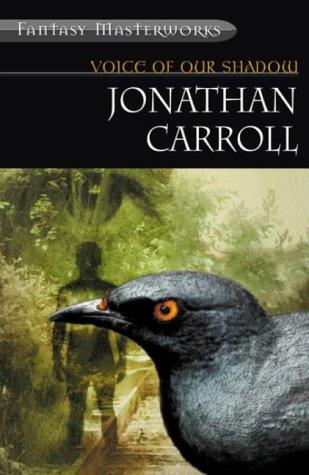
Jonathan Carroll, Voice Of Our Shadow (1983) FMW 25

The extraordinary emerges from the ordinary.

Jonathan Carroll's second entry in the Fantasy Masterworks series decentres the quotidian, and then adds a jarring blast of impossibility. The maxim that 'magic is science, misunderstood' seems to suffuse his work, and the reader is constantly left searching to discover if their inability to explain the appearance of the seemingly impossible within narratives which for much of their course are reassuringly everyday is due to their having missed something in the text. They have not; they have, however, been spellbound by the author's singular ability to interweave the extraordinary with the ordinary. Carroll witholds the deployment of the inexplicable elements in his narratives until such time as he created so plausible a rendering of contemporary life within his textual environment that we are willing to accept that such preternatural events could happen inside as well as outside of nature.

So beautifully crafted are the shattering denouments which are a feature of Carroll's work, conjoining as they do so many elements of the structure of his texts and forcefully amplifying their themes, that his books are difficult to describe without revealing plots in their entirety.

Joe Lennox, the protagonist of Voice Of Our Shadow, is responsible in part for the death of his bullying brother Ross whilst in the company of his sibling's streetwise friend, Bobby Hanley. A short story he writes as a purgative based on his brother's life is published, and the rights sold for a sum sizeable enough to allow him to travel and toy with writing for a living. He settles in Vienna and encounters Paul and India Tate, both of whom he becomes close to. Joe and India become romantically involved, and Paul dies shortly after having discovered their infidelity. India spurns Joe, who moves to New York, where he meets Karen. On returning to Vienna determined to resolve the path his future will take, Joe discovers that Ross and Bobby are continuing to exert a malign influence over his life.

Wednesday, August 24, 2005

About this site (updated 24th April 2010)

NEWS 24th April 2010

So the series isn't dead after all. All titles bar one or two have been reissued in a (frankly revolting) new binding, with the elegant black background and colour insets replaced with what I can only describe as 'rhubarb and custard' The only redeeming feature is the fading smear of 'Gollancz yellow' at the top of spine.

Actually, the whole series is giving me cluster headaches.

There's a forthcoming cased edition of 'Childhood's End' in the traditional binding; a forthcoming paperback edition of 'Inverted World' in the 'rhubarb and custard' binding, and a forthcoming paperback edition of 'Helliconia' in a full colour rendering of the new-style binding.

If anyone can work out what the hell is going on, do please tell, because as usual Orion bookswith their customary two-fingered salute to the readers who keep them in business are being less than helpful on their website: yes, you've guessed, no series list, no reference to binding changes, no list of forthcoming titles. It may be worth keeping an eye on the Wikipedia entry (linked to in the sidebar of this site) in the interim.

I've no idea what's happening to the Fantasy Masterworks series, if anything.

I'm going to lie down now.

Before I do, however, be sure to check out a new group dedicated to the SFMW series on Goodreads.

Now I'm feeling disloyal to LibraryThing.

Ah! I'm over it.


NEWS 30th July 2009

Orion books is now at least acknowledging that it has a Twitter account (@orionbooks) on its home page.

However, I wouldn't like you to labour under the misapprehension that Orion actually told me that this was the case. Despite a number of requests for information via my @Diamat Twitter presence, they have dutifully ignored me, doubtless dismissing me as some time-rich crank who has nothing better to do than to badger them with outrageous and unreasonable queries connected with the apparently tiresome matter of when I can next give them some of my money.

Publishers, eh?

This command-and-control, 'bullhorn to the mouth, fingers in the ears' mindset is borne out by the fact that Orion's Twitter presence (28 following, 507 followers) is doing a lot of shouting, not much listening, and failing both to interact with and to reciprocally follow its community entirely. That is, unless you call a tweet to Jonathan Ross an interaction. Perhaps he is a valued customer? Perhaps they're hoping he'll retweet one of their messages to his followers (which won't happen), causing a sales spike (which also won't happen), and a pat on the head (when a slap round the chops would be more appropriate) for Orion PR, or whoever runs their account. Hard to say, as they haven't disclosed who is actually doing the tweeting. Ether way, it's a big slice of #twitterfail on Orion's part. Serving Ross's demographic of 1 (multi-millionaire TV twerp with an enormous Twitter following and a passing interest in SF... on film) isn't really a social media marketing strategy, is it? :)

Orion's SF Masterworks catalogue remains a shocking mess. Some entries are absent altogether; series numbers are missing; titles which have appeared in the series but which have been reissued as movie tie-ins (I Am Legend) or in other editions (the Blood Music 'Future Classics' release, for example) appear in the list in error. The Fantasy Masterworks catalogue, still quiet after #50, fares no better.

In all honesty, it's hard to see how they could be doing a worse job. As someone who has worked in publishing for over a decade, I can't say I'm surprised. As a reader and collector, I can't say I'm not disappointed.

If Orion were setting out to deracinate such brand loyalty as their readers' may still be in possession of, they're exceeding all expectations.

At present, Philip K. Dick's The Man In The High Castle is still listed as the next release in the series with a publication date of 17th September 2009. The striking cover image (which is different to the SFMW hardback edition of the work) confirms the title to be an entry in the SFMW series, but the catalogue - predictably - does not currently denote that it will be #73. As usual with Orion, everything is subject to change and clouded in confusion.

As long time followers will have noticed, I have put a sequential series of cover images up on the site. I hope you like it. Titles that have been reviewed link to the relevant blog entry. Titles that have yet to be reviewed do not resolve.

As far as the reviews themselves are concerned: I hope to publish two in August, one SFMW, one FMW. I apologize for the delay in adding new content. I was made redundant in May 2009 (not fishing for sympathy here, I couldn't be more delighted about it, for various reasons) and have spent most of the last 8 weeks getting a consultancy presence running.

NEWS 9th April 2009
@orionbooks now has a Twitter presence and started posting on 17th March 2009. Again, who knows whether it's official or not, as there is no reference to this on their homepage. I've requested some clarification as to what is going to happen to the SF Masterworks series. I notice that a reference to PKD's The Man In The High Castle has now appeared as listed for publication in September 2009. As you can see from the link to the series above, whilst the binding would lead the reader to believe that this will be entry #73 in the series, it does not currently state that this is indeed the case.

If I hear anything, I'll let you know.

If I don't hear anything, I'll also let you know.

SERIES UPDATE NEWS 26th March 2009
In a textbook example of why catalogues are useless and should be scrapped, none of the releases announced by Orion which I mentioned in the update below were actually issued. Instead, the SF Masterworks series continues with Robert A. Heinlein's The Moon is a Harsh Mistress (#72, December 2008) as a cased edition. In other news, @Gollancz is now on Twitter. Whether they're official, who knows; there's nothing on the Orion site to suggest that this is indeed the case.

SERIES UPDATE NEWS 24th July 2008
According to their latest catalogue, and following on from Dune (#71), it looks like Orion are going to continue reissuing the SF Masterworks they originally published in hardback (lacking the pbk rights) as 'cased' editions. The Man in the High Castle (#72, July 2008), Childhood's End (#73, August 2008), and The Moon is a Harsh Mistress (#74, December 2008) are all teed up thus far. I have high hopes that A Canticle for Liebowitz, The Left Hand of Darkness, and The Day of the Triffids may follow next year, although if they're already recycling the previously published hardbacks, one does wonder how Orion is going to struggle to SF Masterworks #100, where I understand that the series will apparently conclude.

SITE UPDATE 16th August 2008
Having returned to the UK, I am getting back into the swing of this, and thoroughly enjoying it. In order to record some of my genre reading that falls outside of these series, I will be including occasional reviews from two other lists, namely Orion's stunning limited release of titles under the Future Classics banner in 2007, and the elusive Gollancz SF Collectors' Edition (more here). I describe them as 'elusive' only because I have been unable to find a definitive list of which titles have been published in the series, and hope that this enterprise will be one way of answering this question in the fullness of time. You may have noticed that I have also included links to various SF awards. When time allows, I will be adding reviews of some previous winners, too.

Welcome to my SF Masterworks and Fantasy Masterworks review site. This blog is dedicated to reviews of the two parallel series published by Orion under the Millennium imprint. The former was launched in 1999, the latter in 2000. Both series are still in print, with over 130 titles now published, although not all of the works are still available. The publication schedule has slowed significantly in recent years, but new, incrementally-numberred titles continue to be added to both lists in the same highly attractive bindings. A number of the works have been released with different cover images over the years; The Forever War and Almost Human are cases in point.

The editors have done an excellent job of treading the line between the fiscally necessary (i.e. finding reasons to republish those back list titles to which they continue to hold the copyright) and the artistically committed. In genres which are often accused of being written by the yard, both series contain entries which far surpass the confines of genre fiction and deserve a wider audience.

This site will celebrate both the works themselves and Orion's commitment to the future of the series. Pages dedicated to both series appear on the publisher's website, which the sidebar of this blog links to. I am including links to some excellent pages on the SF Site, which is a fabulous resource all round. Amazon's UK site is also a good source of publication information and advance glimpses of the jackets (which are uniformly delightful).

You will also find links to the works on LibraryThing here and here

Thank you for your comments and e-mails, it is great to connect with other readers who enjoy these works.