Showing posts with label 1956. Show all posts

Sunday, May 29, 2011

Walter M. Miller Jr, Dark Benediction (1951-57) SFMW 69

Best known for his Hugo Award-winning A Canticle For Leibowitz (1959), Walter M. Miller Jr also authored dozens of stunning short stories in the 1950s, 14 of which are gathered together in this highly attractive entry into the SF Masterworks series.

The tales are not of uniform quality, but the work's best pieces rank among the very finest examples of the short form in the canon of speculative fiction. Miller's mastery of the post-apocalyptic sub-genre, his struggle to make sense of religious convictions, his attractive, sparse style and the manifestation within his work of the depression it is suggested that he lived with prior to his suicide in 1966 combine to produce a complex, satisfying corpus which merits frequent revisiting.

A child's frantic combing of the future for a cure which medical science has failed to provide for him in 'The Will' (1954) is compelling and mysterious, whilst 'Anybody Else Like Me' (1952) presents meditations on evolutionary telepathy presented in the disturbing contexts of rape.

Construction worker Manue Nanti struggles to come to terms with the atrophying of his lungs in 'Crucifixus Etiam' (1953) on a Mars without faith:
'Faith needed familiar surroundings, the props of culture. Here there were only swinging picks and rumbling machinery and sloshing concrete and the clatter of tools and the wheezing of troffies. Why? For five dollars an hour and keep?' (p. 57).
A 'machine' comes to a sacrificial self-awareness in 'I, Dreamer' (1953) as it learns the truth about its origins, while 'Dumb Waiter' (1952) presents a brilliantly conceived parable about humanity's limited capacity to perceive both its salvation and destruction in the self-regulating yet vulnerable technology it develops as an engineer struggles to save a civilization his peers are intent on destroying:
'Humanity has waited a hundred thousand years before deciding to build technological civilization. If he wrecked this one completely, he might never decide to build another [...] Some men thought that the a return to the soil was desirable. Some men tried to pin their guilt on the machines, to lay their own stupidity on the head of a mechanical scapegoat and absolve themselves with dynamite. But Mitch Laskell [...] liked the purr of a pint-sized nuclear engine much better than the braying of a harnessed jackass' (p. 88).
'Conditionally Human' (1952) is one of the anthology's highlights. The protagonist sets about righting the wrongs the state's strict control of the conditions of reproduction have wrought, 'knowing that it would never be all right [...] as long as the prohibiting, the creating, the killing, the mockery, the falsification of birth, death and life continued [...] He hoped Man could fit into it somehow' (pp. 235, 265).

'Dark Benediction' (1951) provides the volume's titular inspiration and forms its conceptual centre. The story offers a stirring, thematically multi-faceted study of our primitive responses to crises, fear of difference, and qualified contextualization of unexpected and societally transformative change. 'Dark Benediction' provides the reader with an opportunity to reflect upon the fact that destiny is not ours to control, and that unstoppable external forces could radically alter what it means to be human. Our curiosity, the story suggests, could be the death of us in the face of an implacable evolutionary process over which we have no influence; humanity, the story suggests, is not a Leibnizian monad, and we should perhaps be grateful for the universe's attention, whatever the outcome.

Regardless of other stories of lesser quality that it contains, 'Dark Benediction' is an excellent entry into the SF Masterworks catalogue. Miller's perspectives on his topics are usually engaging, often challenging, and occasionally macabre in the extreme; see 'Vengeance For Nikolai' (1957), with a plot as outlandish as anything Jacobean Tragedy has to offer.

'When the machine age cracks up, you crack up, too. Because you never made yourself its master; you just let yourself be mechanically pampered' (p. 105).

'If the universe lets you live, then you're doing all right' (p. 135)

Friday, December 30, 2005

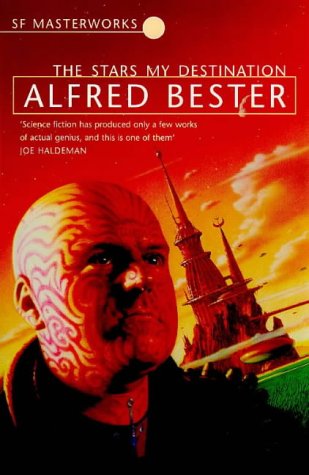
Alfred Bester, The Stars My Destination (1956) SFMW 5

Gully Foyle is my name / And Terra is my nation. / Deep space is my dwelling place / And death's my destination.

On one level, The Stars My Destination (originally published in the USA as Tiger! Tiger!) is an exercise in vengeful monomania. The novel begins with the antiheroic protagonist Gulliver Foyle, Mechanic's Mate 3rd Class ('Education: None; Skills: None; Merits: None; Recommendations: None' (p. 16)) enduring his 170th day in a pressurised tool cupboard, scuttling around the remains of the Nomad, the wrecked, depressurised freighter he was a crew member of, in a patched space suit searching for oxygen and supplies. When the Vorga, a sister ship to the Nomad also belonging to the Presteign clan, discovers but fails to rescue him, the naked rage engendered within Foyle drives him to pursue its crew and enact his revenge. A series of thrilling set pieces follow, that are made just about credible by the verve of Bester's prose: Foyle's reanimation of the Nomad, his escape from the Sargasso Asteroid, and his break out from the Gouffre Martel prison are all highly dramatic. During the course of events, however, Foyle finds himself at the centre of a struggle between the colonists of the Outer Systems and the remaining inhabitants of the Inner Planets, both striving to discover a cache of PyrE, a 'thermonuclear explosive... detonated by thought alone' (p. 248), to assist them in their struggle.

In the midst of this page-turning narrative, as well as unsettling the reader by constructing a homage to the experimental novels of the eighteenth century by means of a sequence of typographical flourishes (p. 233-243), Bester somehow finds time to coin a number of the staple tropes of contemporary SF. Anyone familiar with Iain M. Bank's Culture will recognise the genesis of 'glanding' in the adaptation of Sheffield's salivary glands, 'prepared to respond with an anaphylaxis secretion' (p. 222). Foyle's 'rewiring' with 'microscopic transistors and transformers... buried in muscle and bone' making him 'more machine than man' (p. 128) predates William Gibson's cyberpunk reworking of similar ideas by some 30 years. Furthermore, Bester's description of the abilities Foyle gains as a consequence of his transformation have found their expression in media other than the printed word: it is impossible, for example, not to envision those scenes within which he activates the acceleration 'of every sense and response in his body... by a factor of five' (p. 130), effectively slowing down the world around him, in anything other than Matrix-style 'bullet time'. In addition, we are introduced to a clutch of other ideas, such as 'jaunting' (teleporation by means of will alone), Disease Collectors (p. 153), and Sympathetic Blocks (p. 155), to name but three.

There is nothing to like about 'the walking cancer... Gully Foyle' (p. 103), who has 'robbery and rape', 'blackmail and murder', and 'treason and genocide' (p. 220) to his name. For the first three quarters of the work, Foyle is largely 'Cro-Magnon' (p. 65): 'Run. Fight. Punch. That's all you know. Beat. Break. Blast. Destroy' (p. 86). The tiger-stripe tatoos emblazoned across his head by the inhabitants of the Sargasso Asteroid during his initiation suit the cast of his personality, even more so when he attempts to have them removed only to discover that they reppear when he loses control of his temper. However, just as Blake's god created the tiger as well as the lamb, so Bester, rather than afford the protagonist redemption in the final quarter of the book, chooses instead to recast Foyle as an Everyman figure in an attempt to coerce the reader into associating with him.

Cheated of his revenge, Foyle is made to acknowledge that 'revenge is for dreams... never for reality' (p. 194), and that his autodidactic quest to 'turn [himself] into a thinking creature' (p. 212) has been futile: 'we prattle about free will, but we're nothing but response... mechanical reaction in prescribed grooves' (p. 247). Whilst Foyle may crave punishment and purgation, 'to pay for what [he has] done, and settle the account', he is forcefully reminded that 'there's no escape' (p. 249) from oneself. In a dense series of symbolic exchanges with a malfunctioning bartender robot that appears to manifest an epiphany of independent thought before it expires, we are exhorted with Foyle to accept that life's challenges must be confronted 'because you're alive. You might as well ask: Why is life? Don't ask about it. Live it... Don't ask the world to stop moving because you have doubts... Life is a freak. That's its hope and glory' (p. 251). This exchange leads Foyle to undertake a final wild quest that he hopes will let the world make its own decisions: 'we're all in this together. Let's live together or die together... I make you great. I give you the stars' (p. 255).

On a personal note, this volume is the one that ingnited my interest in the SF Masterworks series. It in every way merits its reputation as a Golden Age classic, and I found it a wonderfully satisfying read, better than any film or TV series. I sincerely hope that it is never filmed. Mind you, I said that about I Am Legend too, and look what happened...

Note: The Stars My Destination was the fourth entry in the 2001 hardback SF Masterworks series (first cover image above), and the fifth entry in the numbered SF Masterworks series (second cover image above). The same cover image was used for both editions, but the former features a quote from Samuel R. Delany, whilst the displays a quotation from Joe Haldeman.