Showing posts with label Hugo. Show all posts

Sunday, August 05, 2012

Arthur C. Clarke, Rendezvous with Rama (1972) SFMW 65

'On a billion television screens, there appeared a tiny, featureless cylinder, growing rapidly second by second. By the time it had doubled its size, no one could pretend any longer that Rama was a natural object. Its body was a cylinder so geometrically perfect that it might have been turned on a lathe - one with centres fifty kilometres apart. The two ends were quite flat, apart from some small structures at the centre of one face, and were twenty kilometres across; from a distance, when there was no sense of scale, Rama looked almost comically like an ordinary domestic boiler.' (Loc. 191-95)

In this manner, Arthur C. Clarke introduces the titular Big Dumb Object  (BDO) of his Hugo and Nebula award winning 1972 novel Rendezvous with Rama.

One of the features of Clarke's fiction is his re-orientation of aspects of human arrangements that tradition has sanctified, and the interpolation of plausible extrapolations from current research. Rendezvous with Rama is no different, with its representation of polygamy (in all combinations; Loc. 586-88) and appealing, but effectively enslaved, superchimps or 'Simps':
Their rearing and education had probably cost as much as that of the average spaceman, and they were worth it. Each weighed less than thirty kilos and consumed only half the food and oxygen of a human being, but each could replace 2.75 men for housekeeping, elementary cooking, tool-carrying and dozens of other routine jobs (Loc. 776-78)
For all this, and as its title suggests, the main interest of the work resides in Clarke's description of the BDO itself. His description of the crew of the survey vessel Endeavour's exploration of Rama's interior is striking, and often suspenseful:
And now he understood the purpose of those mysterious trenches, the Straight Valley and its five companions; they were nothing less than gigantic strip-lights. Rama had six linear suns, symmetrically ranged around its interior. From each, a broad fan of light was aimed across the central axis, to shine upon the far side of the world. (Loc. 1279-81)
However, subsequent to the appearance of the organic automata that cleanse and maintain the BDO during its journey, the text loses much of its mystery, although it retains a good deal of interest:
'What we failed to take into account was the possibility of non-biological survival. If we accept Dr Perera's very plausible theory, which certainly fits all the facts, the creatures who have been observed inside Rama did not exist until a short time ago. Their patterns, or templates, were stored in some central information bank, and when the time was ripe they were manufactured from available raw materials - presumably the metallo-organic soup of the Cylindrical Sea. Such a feat is still somewhat beyond our own ability, but does not present any theoretical problems. We know that solid state circuits, unlike living matter, can store information without loss, for indefinite periods of time. 'So Rama is now in full operating condition, serving the purpose of its builders - whoever they may be.' (Loc. 2762-68)
Ultimately, readers may be disappointed to glean little from the work that can provide them with satisfactory answers to the two questions that exercise the minds of the crew of the Endeavour: 'Who were [the Ramans] -- and what went wrong?' (Loc. 501). This may be asking the wrong questions of Rendezvous with Rama, as one senses that Clarke's purpose was to invite the reader to capture and reflect on the sense of wonder developed within his description of the BDO's geography in this excellent addition to the SF Masterworks series, and take it with them beyond their reading of the novel, and into their own lives:
The nature and the purpose of the Ramans was still utterly unknown. They had used the solar system as a refuelling stop - as a booster station - call it what you will, and had then spurned it completely, on their way to more important business. They would probably never even know that the human race existed; such monumental indifference was worse than any deliberate insult. (Loc. 3294-96)

Saturday, September 03, 2011

Walter M. Miller Jr, A Canticle for Leibowitz (1959) SFMW V

'Over each city a sun appeared and was brighter than the sun of heaven, and immediately that city withered and melted as wax under the torch, and the people thereof did stop in the streets and their skins smoked and they became as fagots thrown on the coals. And when the fury of the sun had faded, the city was in flames; and a great thunder came out of the sky, like the great battering ram PIK-A-DON, to crush it utterly. Poisonous fumes fell over all the land, and the land was aglow by night with the afterfire which caused a scurf on the skin and made the hair to fall and the blood to die in the veins' (p. 198)

'From the confusion of tongues, the intermingling of the remnants of many nations, from fear, the hate was born. And the hate said: Let us stone and disembowel and burn the ones who did this thing. Let us make a holocaust of those who wrought this crime, together with their hirelings and their wise men; burning, let them perish, and all their works, their names, and even their memories. Let us destroy them all, and teach our children that the world is new, that they may know nothing of the deeds that went before. Let us make a great simplification, and then the world shall begin again.' (p. 72)

A cornerstone of the post-apocalyptic SF sub-genre, 1961 Hugo winner
A Canticle for Leibowitz (1959) was the only novel Walter M. Miller Jr published in his lifetime. The work emerged from short stories that Miller published separately, rewritten as the three parts of the final text: Fiat Homo ('Let there be man'), Fiax Lux ('Let there be light'), and Fiat Voluntas Tua ('Let thy will be done').

Fiat Homo is set in the 26th century some centuries after a cataclysmic nuclear war referred to as the 'Flame Deluge' subsequent to which humanity has reverted to a neo-medievalism.

Fiat Lux takes place some six centuries later in 3174 as the Earth emerges from the new Dark Ages into which it has descended and begins to experience 'a revival of learning in a dark world' (p. 174)


Fiat Voluntas Tua occurs a further six centuries in the future in 3781. Technologies have been rediscovered, and humanity teeters on the brink of self-extermination once again.

The novel is set largely within a monastic world of 'bookleggers' and memorizers, custodians of an intellectual history that the 'simpleton' survivors of the Flame Deluge sought to destroy having deemed knowledge to have been the cause of humanity's near-destruction:

'To escape the fury of the simpleton packs, such learned people as still survived fled to the sanctuary that offered itself. When Holy Church received them, she vested them in monks' robes and tried to hide them in such monasteries and convents as had survived.' (p. 73)

The titular character, a scientist before the cataclysmic events that reorient the narrative's history, seeks refuge with the Cistercians:

'Isaac Edward Leibowitz, after a fruitless search for his wife, had fled to the Cistercians[...] Father Isaac Edward Leibowitz had won permission from the Holy See to found a new community of religious[...] Its task, unannounced, and at first only vaguely defined, was to preserve human history for the great-great-great-grandchildren of the children of the simpletons who wanted it destroyed.' (p. 74)

A Canticle for Leibowitz is a brilliant but melancholy work, the relentlessly maudlin nature of which gives some insight into the depressive nature of its author, who took his own life in 1996. It is characterised by its protagonists' lengthy reflections on humanity's seeming inability to cast aside its own predilections towards self-harm, and its inability to break out of its orbiting of disaster and set a heading down a route of progressive, linear development.

'Can you believe that that brute is the lineal descendent of men who supposedly invented machines that flew, who traveled to the moon, harnessed the forces of Nature, built machines that could talk and seemed to think? Can you belive that there were such men?[...] I can't accept it. How can a great and wise civilization have destroyed itself so completely? (p.139).

Man as an 'imperfect incarnation, a dark reflection' (p. 155) of the design of the Creator that he was personally burdened with believing in echoes the title of Miller's famous 'Dark Reflection' short story and gestures towards the dejected world-view of A Canticle for Leibowitz, tempered by fleeting hope: 'Truth could be crucified; but soon, perhaps, a resurrection' (p. 156).

However, it is a burden that Miller, a convert to Catholicism after the Second World War, seems to have been both ill-equipped to bear and unwilling to reconcile himself with. For example, whilst it is ostensibly the character of Abbot Zerchi who enunciates the following passage in the novel, but they seem rather to be being mouthed by the conflicted author himself in the historical context of the late 1950s, with war behind it, war within it, and war ahead of it:

'The world's been in a habitual state of crisis for fifty years. Fifty? What am I saying? It's been in a habitual state of crisis since the beginning – but for half a century now, almost unbearable And why, for the love of God?What is the fundamental irritant, the essence of the tension? Political philosophies? Economics? Population pressure? Disparity of culture and creed? Ask a dozen experts, get a dozen answers. Now Lucifer again. Is the species congenitally insane, Brother? If we're born mad, where's the hope of Heaven? Through Faith alone? Or isn't there any? God forgive me, I don't mean that.' (p. 275)

'Are we helpless? Are we doomed to do it again and again and again? Have we no choice but to play the Phoenix in an unending sequence of rise and fall?[...] Are we doomed to it, Lord, chained to the pendulum of our own mad clockwork, helpless to halt its swing?' (pp. 280-81).

'They had not yet seen the madness and the murder and the blotting out of reason. Then they did it, and then they saw it'. (p. 292)

Abandoning the earth in the novel's final sequence, the last monk to board to the spaceship bearing humanity away from the planet it has been such a poor steward of murmurs Sic transit mundus: 'thus passes the world' (p.338) in much the same way as Kurt Vonnegut shrugged 'so it goes' whenever his authorial eye happened to linger momentarily over the ineluctable stupidity of our species-being.

In A Canticle for Leibowitz, mankind's imbecility and incapacity to learn from the mistakes of its past as it wheels around to embrace future catastophes of its own making is personified in the figure of the omnipresent wanderer or pilgrim. A mythical figure of extraordinary age whose longevity is put down to his partaking of the milk of a mutant goat, the wanderer resembles both an Old Testament prophet, and the person of Leibowitz himself:

'And now this Francis, he meets a pilgrim – wearing what?- wearing for a kit the very burlap cloth they hooded Blessed Leibowitz with before they hanged him. And with what for a belt? A rope. What rope? Ahh, the very same -[...] By tonight, the whole novitiate is buzzing with the sweet little story that Francis met the Beatus himself out there, and that Beatus escorted our boy over to where that stuff was and told him he'd find his vocation' (pp. 52-53)

Published in the stand-alone 10 volume SF Masterworks hardback series, A Canticle for Leibowitz is a superb addition to the SF Masterworks list. It is a haunting, lyric, obsessive, and more than slightly depressing meditation - in many senses of the word - on the ways in which our lives are is lived 'in a dark sea of centuries wherein nothing seem[s] to flow' and within which 'a lifetime [is] only a brief eddy, even for the man who live[s] it.' (pp. 92-93).

'[Change] will come to pass by violence and upheaval, by flame and fury, for no changes comes calmly over the world. It will be so. We do not will it so.[...] Ignorance is king. Many would not profit by his abdication. Many enrich themselves by means of his dark monarchy. They are his Court, and in his name they defraud and govern, enrich themselves and perpetuate their power.[...] They will press the battle upon the world when their interests are threatened, and the violence which follows will last until the structure of society as it now exists is leveled to rubble, and a new society emerges. I am sorry. But that is how I see it.' (p. 228)

'We bury your dead and their reputations. We bury you. We are the centuries' (p. 259)

Sunday, May 29, 2011

Walter M. Miller Jr, Dark Benediction (1951-57) SFMW 69

Best known for his Hugo Award-winning A Canticle For Leibowitz (1959), Walter M. Miller Jr also authored dozens of stunning short stories in the 1950s, 14 of which are gathered together in this highly attractive entry into the SF Masterworks series.

The tales are not of uniform quality, but the work's best pieces rank among the very finest examples of the short form in the canon of speculative fiction. Miller's mastery of the post-apocalyptic sub-genre, his struggle to make sense of religious convictions, his attractive, sparse style and the manifestation within his work of the depression it is suggested that he lived with prior to his suicide in 1966 combine to produce a complex, satisfying corpus which merits frequent revisiting.

A child's frantic combing of the future for a cure which medical science has failed to provide for him in 'The Will' (1954) is compelling and mysterious, whilst 'Anybody Else Like Me' (1952) presents meditations on evolutionary telepathy presented in the disturbing contexts of rape.

Construction worker Manue Nanti struggles to come to terms with the atrophying of his lungs in 'Crucifixus Etiam' (1953) on a Mars without faith:
'Faith needed familiar surroundings, the props of culture. Here there were only swinging picks and rumbling machinery and sloshing concrete and the clatter of tools and the wheezing of troffies. Why? For five dollars an hour and keep?' (p. 57).
A 'machine' comes to a sacrificial self-awareness in 'I, Dreamer' (1953) as it learns the truth about its origins, while 'Dumb Waiter' (1952) presents a brilliantly conceived parable about humanity's limited capacity to perceive both its salvation and destruction in the self-regulating yet vulnerable technology it develops as an engineer struggles to save a civilization his peers are intent on destroying:
'Humanity has waited a hundred thousand years before deciding to build technological civilization. If he wrecked this one completely, he might never decide to build another [...] Some men thought that the a return to the soil was desirable. Some men tried to pin their guilt on the machines, to lay their own stupidity on the head of a mechanical scapegoat and absolve themselves with dynamite. But Mitch Laskell [...] liked the purr of a pint-sized nuclear engine much better than the braying of a harnessed jackass' (p. 88).
'Conditionally Human' (1952) is one of the anthology's highlights. The protagonist sets about righting the wrongs the state's strict control of the conditions of reproduction have wrought, 'knowing that it would never be all right [...] as long as the prohibiting, the creating, the killing, the mockery, the falsification of birth, death and life continued [...] He hoped Man could fit into it somehow' (pp. 235, 265).

'Dark Benediction' (1951) provides the volume's titular inspiration and forms its conceptual centre. The story offers a stirring, thematically multi-faceted study of our primitive responses to crises, fear of difference, and qualified contextualization of unexpected and societally transformative change. 'Dark Benediction' provides the reader with an opportunity to reflect upon the fact that destiny is not ours to control, and that unstoppable external forces could radically alter what it means to be human. Our curiosity, the story suggests, could be the death of us in the face of an implacable evolutionary process over which we have no influence; humanity, the story suggests, is not a Leibnizian monad, and we should perhaps be grateful for the universe's attention, whatever the outcome.

Regardless of other stories of lesser quality that it contains, 'Dark Benediction' is an excellent entry into the SF Masterworks catalogue. Miller's perspectives on his topics are usually engaging, often challenging, and occasionally macabre in the extreme; see 'Vengeance For Nikolai' (1957), with a plot as outlandish as anything Jacobean Tragedy has to offer.

'When the machine age cracks up, you crack up, too. Because you never made yourself its master; you just let yourself be mechanically pampered' (p. 105).

'If the universe lets you live, then you're doing all right' (p. 135)

Sunday, August 30, 2009

Daniel Keyes, Flowers For Algernon (1966) SFMW #25

“Who’s to say that my light is better than your darkness? Who’s to say death is better than your darkness? Who am I to say?” (p. 175)

A 1960 Hugo-winning short story that was later expanded into a Nebula-winning novel in 1966, the first-person narrative of Daniel Keyes’ work in its long form begins with Charlie Gordon (IQ: 68) reflecting to the best of his current abilities on the possibility that the procedure to be performed on him may reconnect him with his family. The reasons as to why he is no longer in contact with them are unclear at this stage, but powerfully described later in the work: ‘I dint see my mother or father or my littel sister Norma for a long long long time. Maybe their ded to. Dr. Strauss askd me where they use to live. I think in brooklin. He sed they will see if maybe they can find them[…] If the operashun works and I get smart maybe Ill be abel to find my mom and dad and sister and show them. Boy woud they be serprised to see me smart just like them and my sister’ (pp. 4, 9)

The first signs of Charlie’s improved cognitive abilities manifest themselves within the confines of his workplace, a bakery: ‘I worked the dough-mixer and everybody was surprised epeshully Frank Reilly. Fanny Birden got exited because she said it took Oliver 2 years to learn how to mix the dough right and he went to bakers school. Bernie Bate who helps on the mashine said I did it faster then Oliver did and better. Nobody laffed. When Gimpy came back and Fanny told him he got sore at me for working on the mixer.’ (p. 25)

Throughout the work, Keyes considers the emotional strain of Charlie’s development from within and without. External observers such as Dr. Strauss, one the project’s co-ordinators advise him that “The more intelligent you become the more problems you’ll have, Charlie. Your intellectual growth is going to outstrip your emotional growth. And I think you’ll find that as you progress, there will be many things you’ll want to talk to me about. I just want you to remember that this is the place for you to come when you need help.” (p. 33)

The treatment Keyes envisages being capable of augmenting cognitive development combines psychosurgery, enzyme injections and psychosomatic programming (p. 48), and Charlie’s scholarly development is rapid: ‘My studies are going well. The university library is my second home now. They’ve had to get me a private room because it takes me only a second to absorb the printed page, and curious students invariably gather around me as I flip through my books.’ (p. 68)

Disappointment awaits him, however, in his discovery that the average academic’s cordon of knowledge is extremely narrow. He quizzes an economics professor on the political implications of economic policies adopted by the American government between the 1918 and 1939: ‘He listened quietly, staring off into space, and I assumed he was collecting his thoughts for an answer, but a few minutes later he cleared his throat and shook his head. That, he explained apologetically, was outside his field of specialization[…] The same thing happened when I tried to discuss Chaucer with an American literature specialist, questioned an Orientalist about the Trobriand Islanders, and tried to focus on the problems of automation-caused unemployment with a social psychologist who specialized in public opinion polls on adolescent behaviour. They would always find excuses to slip away, afraid to reveal the narrowness of their knowledge.’ (pp. 68, 69). Similarly, Charlie finds it ‘terrifying’ (p. 104) to hear academics confess to ignorance of vistas of their own disciplines, let alone those that lay outside them, and is soon led to conclude that even his own mentors are ‘Frauds[…] They had pretended to be geniuses. But they were just ordinary men, working blindly, pretending to be able to bring light into the darkness. Why is it that everyone lies? No-one I know is what he appears to be.’ (p. 105)

Keyes, who clearly has a rather jaundiced view of the academic life, has his protagonist proclaim himself to have ‘learned that intelligence alone doesn’t mean a damned thing. Here in your university, intelligence, education, knowledge have all become great idols. But I know now there’s one thing you’ve all overlooked: intelligence and education that hasn’t been tempered with human affection isn’t worth a damn.” (p. 173)

Things also take a rapid turn for the worse at the bakery as Charlie's IQ burgeons: ‘And so it went[...] It had been all right as long as they could laugh at me and appear clever at my expense, but now they were feeling inferior to the moron. I began to see that by my astonishing growth I hade made them shrink and emphasized their inadequacies. I had betrayed them, and they hated me for it.’ (p. 74).

Algernon’s capabilities quickly develop to the point where Strauss feels the need to remind him that if he is to communicate effectively, he must pitch his discourse at a level his academic audience can understand: ‘Strauss again brought up my need to speak and write simply and directly so that people will understand me. He reminds me that language is sometimes a barrier instead of a pathway. Ironic to find myself on the other side of the intellectual fence.’ (p. 79)

Charlie liberates Algernon, the mouse upon which his treatment was successfully conducted (or so it appeared) in animal trials, at a dinner held to mark the success of the experiment: ‘“Come on,” I said, “We’ll get out of here together.” He let me pick him up and put him into my jacket pocket. “Stay in there quietly until I tell you.”[…] “I’ll just get my things packed,” I said, “And we’ll take off – just you and me – a couple of man-made geniuses on the run.”’ (pp. 114, 115)

After some prevarication, Charlie decides to visit his father, now estranged from his mother, who is running a barber’s shop. Not surprisingly, his parent does not recognize him: ‘How could I tell him? What was I supposed to say? Here, look at me, I’m Charlie, the son you wrote off the books? Not that I blame you for it, but here I am, all fixed up better than ever. Test me. Ask me questions. I speak twenty languages, living and dead; I’m a mathematical whiz, and I’m writing a piano concerto that will make them remember me after I’m gone. How could I tell him? How absurd I was sitting in his shop, waiting for him to pat me on the head and say “Good boy”. I wanted his approval, the old glow of satisfaction that came to his face when I learned to tie my own shoelaces and button my sweater. I had come here for that look in his face, but I knew I wouldn’t get it.’ (p.131)

There still moments of calm at the centre of the novel where Charlie can both look back at what he was and forward to what he may become, although the rising fear of a reciprocal decline in his powers cannot be quelled: ‘I have often reread my early progress reports and seen the illiteracy, the childish naïveté, the mind of low intelligence peering from a dark room, through the keyhole, at the dazzling light outside. In my dreams and memories I’ve seen Charlie smiling happily and uncertainly about what people around him are saying. Even in my dullness I knew I was inferior. Other people had something I lacked – something denied me. In my mental blindness, I had believed it was somehow connected with the ability to read and write, and I was sure that if I could get those skills I would have intelligence too[…] That’s the problem, of course. I don’t know how much time I have. A month? A year? The rest of my life? That depends what I find out about the psychophysical side-effects of the experiment.’ (pp. 139, 146)

It is difficult to state with precision when Charlie’s decline commences as Keyes draws the reader into his protagonist’s attempt to explain to himself what the grey areas that begin to encroach on the margins of his consciousness may signify. On the one hand, he senses himself to be ‘on the edge of it. I sense it. They all think I’m killing myself at this pace, but what they don’t understand is that I’m living at a peak of clarity and beauty I never knew existed. Every part of me is attuned to the work. I soak it up into my pores during the day and at night – in the moments before I pass off into sleep – ideas explode into my head like fireworks. There is no greater joy than the burst of solution to a problem’. (p. 167) On the other (as is this, perhaps, where the regression begins?), he wishes to convince himself that he has ‘gone as far as [he] can on a conscious level, and now its down to those mysterious operations below the level of awareness.’ (p. 168)

Either way, however, he is aware of the fact that his experience has, for a time at least, allowed him to rise above those ‘souls withered from the beginning, and doomed to stare into the time and space of every day[…] Whatever happens to me, I will have lived a thousand normal lives by what I might add to others not yet born.’ (pp. 160-61, 167)

The decline of Charlie’s powers is rapid. The decline of his self-study into the ‘Algernon-Gordon Effect’ concludes emphatically that ‘ARTIFICIALLY-INDUCED INTELLIGENCE DETERIORATES AT A RATE OF TIME DIRECTLY PROPORTIONAL TO THE QUANTITY OF THE INCREASE.’ (p. 177)

‘Algernon died two days ago[…] Dissection shows that my predictions were right. Compared to the normal brain, Algernon’s had decreased in weight and there was a general smoothing out of the cerebral convolutions as well a deepening and broadening of brain fissures.’ (pp. 179-180)

‘I put Algernon’s body into a small metal container and took him home with me. I wasn’t going to let them dump him into the incinerator. It’s foolish and sentimental, but last last night I buried him in the back yard. I wept as a put a bunch of wild flowers on the grave.’ (p. 180)

‘October 3 - Downhill. Thoughts of suicide to stop it all now while I am in control and aware of the world around me. But then I think of Charlie waiting at the window. His life is not mine to throw away. I’ve just borrowed it for a while, and now I’m being asked to return it.’ (pp. 193-94).

The power of Daniel Keyes’ best-known work resides in its ability to provoke the reader to consider how their own cognitive abilities shape their view of the world. Do we perceive everything that we are capable of perceiving? Are we even capable of ascertaining what we may be missing? Would it be possible to connect with that which seems to elude us if we could better ourselves? And if we could, what imperceptible potentialities may reside beyond, receding into an infinite realm of experience, denied to us in stages? Are our own powers waxing or waning? Are we any more or any less ourselves, or our lives of more or less value as a consequence?

Sunday, September 14, 2008

Dan Simmons, Hyperion (1989)

'We're not six fucking pilgrims, we're a mob. Hoyt there with his cruciform carrying the ghost of Paul Duré. Our "semisentient" erg in the box there. Colonel Kassad with his memory of Moneta. M. Brawne there, if we are to believe, carrying not only an unborn child but a dead Romantic poet. Our scholar with the child his daughter used to be. Me with my muse. The Consul with whatever fucking baggage he's brought to this insane trek.' (p. 405)

Winner of the 1990 Hugo, Dan Simmons' Hyperion shamelessly cribs the structure of The Canterbury Tales. The pilgrims draw lots to tell their tales in order to diffuse the tension (rather than break the tedium, as in the original) of their seemingly doomed journey to appease the destructive, chrome and blade-encrusted diety the Shrike, and in so doing influence the outcome of the incipient war between the Hegemony and the renegade Ousters.

The cumulative thematic significance of 'The Priest's Tale: the man who cried god' (p. 23), 'The Soldier's Tale: the war lovers' (p. 114), 'The Poet's Tale: Hyperion cantos' (p. 172), The Scholar's Tale: the River Lethe's taste is bitter' (p. 237), 'The Detective's Tale: the long good-bye' (p. 315) and 'The Consul's Tale: remembering Siri' (p. 410) imbues the work with a wonderful poise and balance. It is a tremendously satisfying read, and as the protagonists dance hand in hand down the yellow brick road towards their doom (I am being entirely literal rather than figurative here), the reader will be grabbing their coat to scamper off to the bookshop to buy the sequel, The Fall of Hyperion

Sunday, May 25, 2008

Frank Herbert, Dune (1965) SFMW 71

I must not fear.
Fear is the mind-killer.
Fear is the little-death that brings total obliteration.
I will face my fear.
I will permit it to pass over me and through me.
And when it has gone past I will turn the inner eye to see its path.
Where the fear has gone there will be nothing.
Only I will remain.


Dune is more mythos than novel and has spawned innumerable spin-off books, films and mini-series. As such, it is something of a challenge to review the original works, Dune World (1963-4) and The Prophet of Dune (1965), most commonly referred to as the amalgamated novel Dune, first published in this format in 1965 and winner of the Hugo and Nebula awards for best novel in the same year.

At over 550 pages in this edition (the first hardback entry in the main SF Masterworks series, presumably for rights reasons), Dune is often lazily referred to as 'science fiction's Lord of the Rings'. There is little real merit to this analogy: yes, it is a study of good versus evil; yes, there are a number of rich and overlapping cultures portrayed in the book (the empire with its Houses and Guilds, the warped Buddhism of the Bene Gesserit 'witches', the near-eastern influences suffusing the culture of the Fremen desert tribes, the sandworms of Arrakis and the consciousness-altering spice melange drug that they make) but other than the fact that both works are engaging tales, expertly told, there is little more to say.

Dune is on one level a personal, political, emotional and spiritual bildungsroman, tracing the passage of Paul Atreides, son of Duke Leto Atreides and the Lady Jessica, Bene Gesserit and concubine to the Duke, from usurped ducal heir to the Lisan al-Gaib, a prophet who will lead the native Fremen people of Dune on a program of land reclamation, turning the desert to verdure.

However, to describe the novel only in these terms does a disservice to its dense and complex structure, and each reader will find a different path through it. I was particularly struck by the contemporary (i.e. mid-'60s) significance of Herbert's insistence that women (the Bene Gesserit) are covertly running the political world through their machinations, interventions, and breeding programs. To me, this seemed less to signify a progressive social emancipatory urge on the author's part than to disclose (perhaps unconsciously) a certain Cold War paranoia, with women taking the place of the Russian agents and the KGB.

Note: Dune was the first entry in the 2001 hardback SF Masterworks series, and the seventy first entry in the numbered SF Masterworks series (cased). The same cover image was used for both editions.

Tuesday, January 03, 2006

Joe Haldeman, The Forever War (1974) SFMW 1

It is 1997. Subsequent to the destruction of a colonists' ship near Aldebaran in the constellation of Taurus, the world is at war with the Taurans.

Warfare is space is deemed to be too complicated for the traditional jarhead, and the first draft of infantry enlisted by the Elite Conscription Act of 1996 consists of 'fifty men and women, with IQs over 150 and bodies of unusual health and strength' (p. 9). One of them is Private William Mandella.

The organisationally faceless, emotionally featureless monstrosity that is any army gets a particularly severe working over in this book. Servicemen and women are groomed to participate in a soulless round of endorsed drug taking, orgies and post-hypnotic suggestion in between bouts of combat, which the protagonist quietly dissociates himself from during the course of the novel.

The work forecefully demonstrates how conflict strips humanity of all the facets of existence which give life meaning and value, leaving an empty husk:
'the thought came to me that the next time I closed my eyes could be my last. And partly because of the drug hangover, mostly because of the past day's horrors, I found that I really didn't give a shit' (p. 58); 'I was disgusted with the human race, disgusted with the army and horrified at the prospect of living with myself' (p. 73).
Haldeman's own experiences in Vietnam season this taut narrative with arresting, sometimes shocking, descriptions of the grimly visceral and unremittingly futile nature of warfare.

The text features some interesting pseudo-hard science devices. This is a universe in which 'collapsar Stargates' have been discovered, which facilitate the bending of relativity at the expense of time dilation. With the many stargate jumps that Mandella completes to reach the conflicts his unit participates in, he finds that the Earth that he left has changed beyond recognition on his return during his 1,100 year career. We as readers share Mandella's 'future shock' (p. 99) as he returns to a world of nine billion inhabitants run by the UN, two thirds of whom are unemployed, blighted by plagues and disasters, with an 'undeclared class war going on all over the world' (p. 111-113).

Furthermore, 'the most important fact about the war to most people was that if it ended suddenly, Earth's economy would collapse' (p. 131) as 'nearly half the jobs in the world were associated with the war, and if it stopped, everything would fall apart' (p. 143). The protagonist endures further jolts as he returns from future missions to discover that humanity has become first societally homosexual, then heterosexual again - but cloned.

Whilst SF as a genre continues to spawn series of lazy works which still deem it necessary to dedicate entire volumes to their protagonists' infinitely tedious careers, The Forever War unfolds the story of Mandella's unwilling and hapless progress through the ranks, and his poignant relationship with fellow conscript Marygay Potter, in a mere 250 pages. Mandela and Potter's careers run in parallel for the first two-thirds of the work, but when they are both promoted to a senior officer's rank and assigned to different units, they realise that 'in different ships, the geometry of the collapsar jump would pile up years between [them]. When the second one arrived on Earth, his partner would probably be a half-century older; more probably dead' (p. 168).

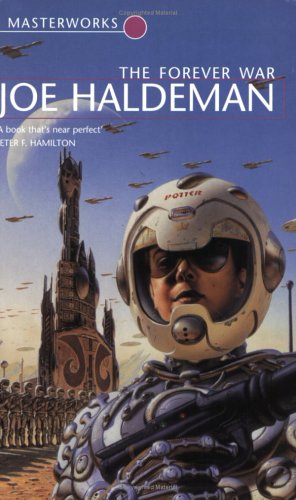
The Forever War has endured a convoluted history as an entry in the SF Masterworks series, having enjoyed four different imprints to date. Originally published in paperback as the series' inaugural entry in January 1999 with the title and author's name printed against a black background (first image), The Forever War was reissued a hardcover in 2001 (second image). An excerpt from the same Chris Moore artwork also provided the cover image for this edition, this time being blown up to provide a full-page illustration. As an aside: this release was one of ten titles published as part of a short-lived accompanying series of SF Masterworks to which Orion held the hardcover, but not the paperback rights. Of the ten titles, only The Forever War and The Stars My Destination had also been published in paperback, although of the remaining eight, Ringworld has subsequently received a paperback release, presumably subsequent to the rights having been reclaimed (or perhaps, knowing Orion, rediscovered). The paperback was reissued in 2003 with a new cover (third image above), and most recently in 2010 using the same image in the latest unnumbered design format.

Monday, December 26, 2005

James Blish, A Case Of Conscience (1958) SFMW 30

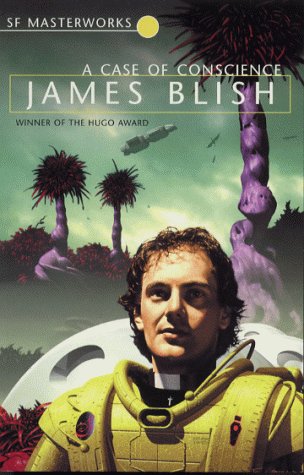
The devil inside?

Biologist Father Ramon Ruiz-Sanchez is a part of a mission to determine whether the seemingly Edenic planet Lithia should be colonised and exploited. Whilst he is fascinated by the planet as a biologist, the 'transinfinite coincidence' (p. 76) of the existence of Lithia's sinless, anthropomorphised lizards appears to demonstrate to the priest that 'ethics can exist without evil alternatives', 'morals can exist without conscience', and 'goodness can exist without God' (p. 82), thereby undermining the fundamental precepts of his Catholicism and leading him to formulate the heretical Manicheanism that 'henceforth there is to be no more God, but only phenomenology' (p. 83).

The exploration team return to Earth with a gift from the Lithians of an embryonic member of their own species. Egtervechi develops from a tadpole to a young adult in little more time than it takes to complete the voyage, is naturalised as a citizen, and quickly rises to a position of cultural preeminence by means of a television program that he hosts. In his mental and emotional displacement from his own people, Egtervechi comes to articulate the alienation at the heart of the culture delineated in A Case Of Conscience. Blish posits that the contemporary arms race that he composed this work in the middle of would evolve into a 'Shelter' race, with nation states building vast bunker cities underground and abandoning surface living. A 'preacher without a creed, an intellect without a culture, a seeker without a goal', appealing 'to all those who feel cut off, emotionally and intellectually' (p. 154), Egtervechi is something of a cross between Milton's Lucifer and the Edenic 'Snake' (p. 149 et al), and the dissent that he engenders within Shelter society finds its final expression in a series of riots that threaten to destroy it as 'the beast Chaos roar[s] on' (p. 170).

A worthy entry in the SF Masterworks series as winner of the 1959 Hugo Award, A Case Of Conscience supports the assertion that James Blish's canon stands as a bridge between 'Golden Age' SF and the contemporary genre. In developing its theologically allusive, intellectually provoking argument, Blish (a life-long atheist) demonstrates that whilst fideism may innoculate the believer against certain delusions, the chimerical basis of religion ultimately dulls perspicacity to a point where the obvious becomes obscured by the seemingly pre-ordained. Hence whilst the reader may understand the destruction of Lithia at the end of the work to be the consequence of the disastrous failure of a high-energy experiment, Ruiz-Sanchez's faith perceives it to be the inevitable outcome of a planetary exorcism.

'That is what evil does - it empties you'.

Thursday, August 25, 2005

Larry Niven, Ringworld (1970) SFMW 60

Between the finite and the infinite

Larry Niven's Ringworld has a mundane plot. A party of adventurers crash on an alien artefact and attempt to escape from it. The plot, however, is to all intents and purposes irrelevant. I am gripped by the conviction that Niven envisaged the artefact in question and simply wanted to come up with a vehicle to describe it over the course of 280 pages or so. The construction in question is a solid band circling a planet, a million miles in radius which has been terraformed by architects whose presence is still felt despite their absence, and which has now fallen into decay. Niven muses over the intricacies of its form and function, from the foundation material to the cloud squares which separate night from day, and constructs a wholly convincing environment in so doing. A few paragraphs of scant description will not do his successes in this regard justice, and I would recommend reading it for these evocations of a vast alien environment alone. Ringworld's habitats remind us of our own, yet are described as being of such a scale as to make the reader feel insignificant even within the pages of the book. On closing it, our own world seems rarer and less familiar, increasing in magnitude as we ourselves diminish, overturning the familiar trope of 'the shrinking world' and letting us once again revel in the scale of nature. Iain M. Banks' Consider Phlebas reworks the idea of the ringworld to great effect, but Larry Niven got there first.

Winner of the 1971 Hugo Award, Ringworld is also noteworthy for some (but not all) of its characters. The four adventurers are (ostensibly) led -- or, more accurately, hired by -- Nessus of the Puppeteers, who resembles a large semi-plucked turkey with two necks, a brace of python heads, and bipolar disorder. Speaker To Animals is an oversized brawny ginger tom cat of the warlike Kzin race, which has battled mankind for centuries and been overthrown as a consequence of the Puppeteers technological intervention on behalf of humanity. As it turns out, the Puppeteers have been manipulating both races for their own ends, a fact which Niven (hilariously) tries to deploy as a plot twist; but the clue is in the name, isn't it? The two humanoids, Louis Wu (chosen for his experience) and Teela Brown (chosen for her supposed luck) are, frankly, tedious, and the exposition regarding their relationship slows the book to down to a crawl in a places.

In summary, whilst I could hardly recommend Ringworld for the telling of its story alone, Niven's peerless description of an alien artefact of almost incomprehensible enormousness is what makes this book so satisfying. Take his conjuration of some of that wonder from it and see your own world through it. The SF Masterworks edition's cover is absolutely stunning, too.

Note: Ringworld was the eighth entry in the 2001 hardback SF Masterworks series (second cover image above), and the sixtieth entry in the numbered SF Masterworks series (first cover image; 2005). A printing error saw the volume bear the number '72'.